
When a Blind Box Manufacturer Turns Plastic into Chrome — Inside the Vacuum Metallizing Chamber
There is a moment on every blind box manufacturer's production line when a dull, matte plastic part disappears into a vacuum chamber and emerges looking like polished silver. The transformation is sudden and almost theatrical: whatever came out of the injection mold — a miniature helmet, a robot's visor, a character's chest plate — now reflects light like a mirror, and the customer holding the figure cannot tell whether it is plastic or metal. This is vacuum metallizing, and for a blind box manufacturer, it is the single process that most dramatically changes a product's perceived value.
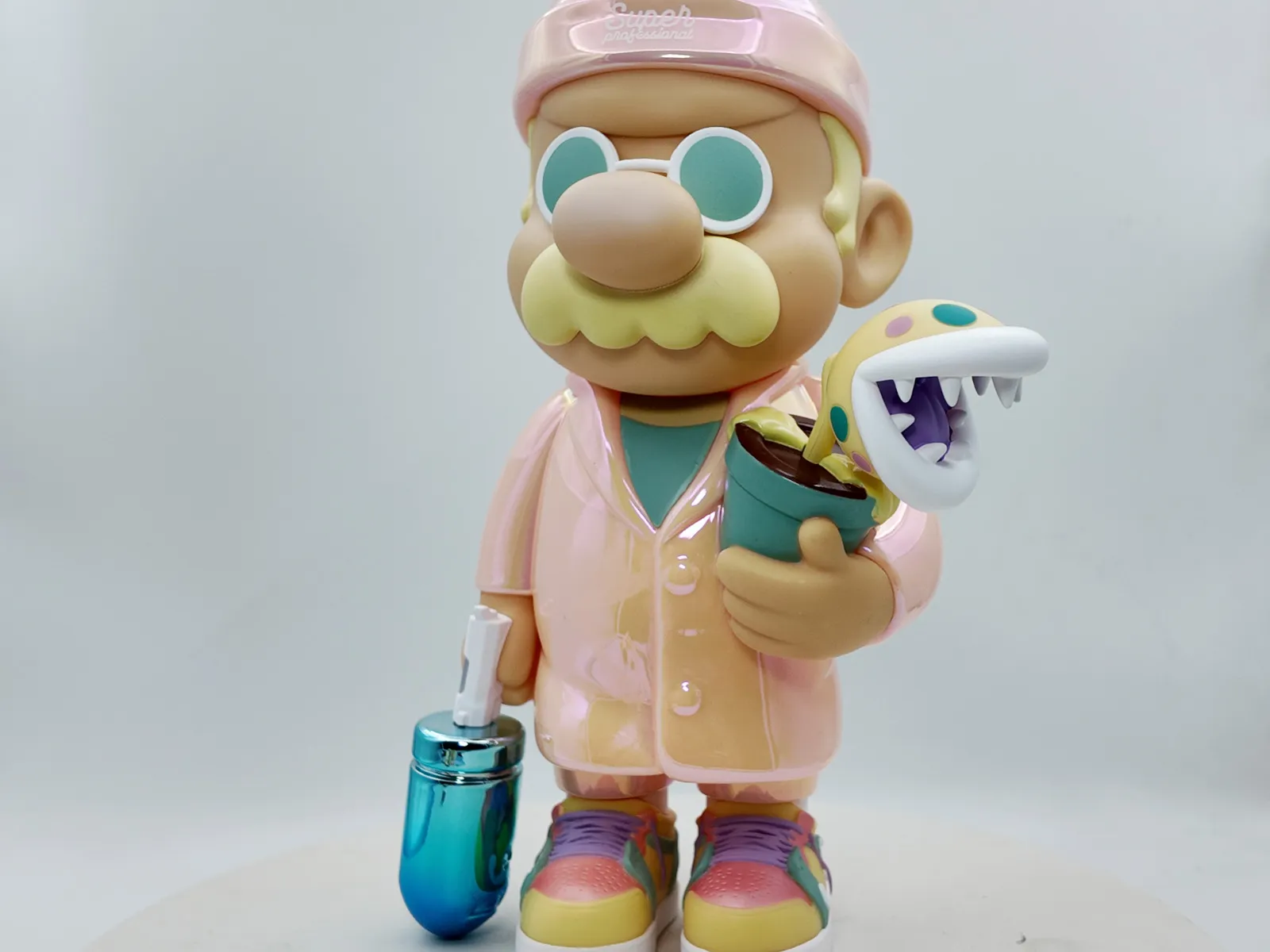
Why Vacuum Metallizing Instead of Wet Plating
A blind box manufacturer has two options for creating a metallic surface on plastic: wet (electrochemical) plating and vacuum (physical) plating. Wet plating produces thick, durable metal layers with excellent adhesion, but it only works on ABS and ABS+PC blends, requires hazardous chemical baths, generates significant wastewater, and needs conductive pre-treatment. For a blind box manufacturer running PS, PP, PC, PA, PMMA, or hard PVC figures — which wet plating cannot process at all — vacuum metallizing is the only viable metallic finish option. Vacuum metallizing works on virtually every plastic a blind box manufacturer uses. The process deposits metal by physical vapor deposition: heat a metal until it evaporates inside a vacuum chamber, and the vapor condenses on whatever surfaces it touches. No chemical baths, no conductive pre-coating, no wastewater.
The trade-off: vacuum metallized films are thin (0.01–0.1 μm) and inherently fragile. They cannot withstand rough handling without a protective topcoat, and their adhesion depends entirely on the quality of the base coat beneath them. A blind box manufacturer who skips or rushes either coat will see the metallic layer peel, scratch, or discolor within days. This is why the vacuum metallizing process is not just about the vacuum chamber — it is about the entire coating sequence that surrounds it.
The Full Seven-Step Process
A blind box manufacturer's vacuum metallizing line is a seven-step sequence, not a single operation. The vacuum chamber is step four. Everything before it prepares the surface; everything after it protects the film.
Step 1 — Pre-treatment: The injection-molded part arrives with surface contamination that must be removed. Mineral grease and oil residues are cleaned with emulsion-type detergents; animal-based oils respond to 10% sodium hydroxide solutions; silicone-based mold release agents — the worst enemy of vacuum metallizing adhesion — require trichloroethylene or perchloroethylene. A blind box manufacturer who uses silicone-based mold release on parts destined for vacuum metallizing is creating an adhesion problem that no amount of base coat can fix. After cleaning, parts are oven-baked to remove absorbed moisture that would vaporize during vacuum deposition and create bubbles in the metal film.
Step 2 — Jigging: Parts are mounted on rotating cage frames that will spin inside the vacuum chamber. Every part must be secured so it does not fall off during rotation, positioned so evaporating metal reaches all surfaces evenly, and held at a contact point that will not show on the finished product. A blind box manufacturer typically leaves the gate runner attached as a jigging contact point, then clips it off after plating. Operators must never touch the surfaces that will receive the metallic film — finger oils leave invisible deposits that become visible defects after plating.
Step 3 — Base Coat: The base coat does three things: fills surface imperfections on the injection-molded part, provides a smooth, mirror-like substrate that the metal film will replicate exactly, and blocks residual gases from the plastic that would otherwise bubble through the metal during vacuum deposition. Without the base coat, a blind box manufacturer's vacuum-plated surface would be dull, uneven, and prone to blistering. Modern blind box manufacturer operations use UV-curable base coats that cure in seconds under ultraviolet light — compared to 2–3 hours of oven baking for traditional thermosetting paints — processing three to four times more parts per shift.
Step 4 — Vacuum Deposition: The jigged parts roll into the vacuum chamber. Pumps engage — first the mechanical pump pulls to rough vacuum, then a Roots blower accelerates the draw, and finally a diffusion pump reaches operating vacuum at 0.067 Pa (approximately 5 × 10⁻⁴ Torr). At this pressure, air molecules are so sparse that evaporated aluminum atoms travel in straight lines from the heated tungsten filament to the rotating parts without colliding with anything en route.
The blind box manufacturer's operator wraps high-purity aluminum wire segments around tungsten filaments inside the chamber. When the filament heats to 650°C, the aluminum melts and wets onto the tungsten wire. As the temperature rises toward 1000°C, the molten aluminum evaporates, and individual aluminum atoms fly outward in all directions. The rotating cage frames ensure uniform deposition. A typical plating cycle takes approximately 30 minutes. The deposited aluminum film is extraordinarily thin — typically 25–50 nm — not a solid metal layer but a semi-opaque metallic smoke that reflects light like chrome because it is smooth and continuous at the optical wavelength scale.

Step 5 — Top Coat: The aluminum film that just formed inside the vacuum chamber is as fragile as a soap bubble. It scratches with a fingertip, oxidizes in ambient air, and dissolves in mild solvents. The top coat is a transparent protective layer — typically polyester-based for aluminum films — that seals the aluminum against oxidation and physical damage while creating a receptive surface for subsequent dyeing. Without the top coat, the aluminum film would darken and degrade within hours of exposure to normal atmospheric conditions.
Step 6 — Dyeing: If the blind box manufacturer wants a metallic finish that is not silver, dyeing converts the chrome-like aluminum into gold, copper, gunmetal, or any other metallic hue. The dye is applied to the top coat surface, not directly to the aluminum. The hot-dye method is standard: dissolve dye powder in water at approximately 300:1 ratio, heat to 75–85°C, immerse the plated part for 3–12 seconds with constant agitation, then rinse twice in clean water. Color variation is corrected by adjusting dye concentration, immersion time, and solution temperature.
Step 7 — Final Cure, Gate Removal, and QC: After dyeing, the blind box manufacturer cures the top coat at 70°C for 30–40 minutes. Operators wearing gloves clip off the sprue left for jigging, inspect parts for pinholes, orbit lines from uneven rotation, and scratches from careless handling, and test adhesion using the tape-pull method. If the aluminum layer pulls off with the tape, the base coat adhesion has failed and the batch must be reprocessed.
What the Injection Molded Part Must Deliver
Vacuum metallizing does not forgive substrate sins. A blind box manufacturer who sends a poorly molded part to the plating line will pay for it in rework, rejects, and customer complaints. The requirements are strict: surface cleanliness with no oil or mold release residue (especially silicone-based agents), surface smoothness (the base coat fills micro-defects but cannot compensate for macro-level texture), low internal stress (use lower injection pressure and higher melt temperature for plating-grade parts), and correct wall thickness (below 0.9 mm deforms during the plating cycle; above 3.8 mm shows unconcealable sink marks). Design geometry also matters: large flat surfaces need a slight crown of 0.1–0.15 mm convex per centimeter, blind holes should not exceed half their diameter in depth, and V-grooves need a width-to-depth ratio greater than 3.
Three Deposition Methods — Why Evaporation Wins
Vacuum metallizing offers three PVD methods: evaporation (thermal vaporization), magnetron sputtering, and ion plating. A blind box manufacturer almost always selects evaporation because it has the highest throughput and lowest operating cost. Magnetron sputtering produces films with better adhesion — deposited atoms arrive with higher kinetic energy — but is slower, requires more maintenance, and costs more per unit. Ion plating combines evaporation with ion acceleration for near-sputtering adhesion quality, but the equipment is more complex and the process is slower. Resistance-heated tungsten filament evaporation of aluminum wire is the blind box manufacturer's default: it is fast, cheap, and produces a mirror-smooth film that meets decorative requirements. Production cycles average 30 minutes per batch.
When It Fails: Defects a Blind Box Manufacturer Cannot Ship
Three common vacuum metallizing defects destroy product quality. Oil pooling: base coat or top coat accumulates in thick blobs, creating localized dull spots — fixed by adjusting spray parameters and viscosity. Scratches: the aluminum film or top coat is physically abraded during handling — mitigated by glove handling, paper interleaves between parts, and sealed container storage. Delamination: the worst defect, meaning base coat adhesion has failed entirely. Reprocessing requires stripping the entire coating sequence with hot sodium hydroxide solution (1:20 ratio, 30 minutes at boiling temperature) and re-running all seven steps. The root cause is almost always poor surface cleaning, silicone contamination, or insufficient base coat curing. A blind box manufacturer who tracks delamination rates can usually identify the root cause within one or two production cycles. Most quality systems limit re-plating cycles to two or three before the part is classified as irrecoverable scrap, as repeated caustic exposure weakens the plastic substrate.
Why Vacuum Metallizing Is the Strategic Direction
Environmental regulation is the long-term driver. Wet plating generates chromium, nickel, and cyanide-bearing wastewater requiring expensive treatment and permits. Vacuum metallizing generates none of these — the process is dry, the only waste is spent aluminum wire and tungsten filament fragments, and the coating materials are paint-based. For a blind box manufacturer operating under tightening environmental standards, vacuum metallizing is not just a process choice; it is a compliance strategy. Beyond compliance, the blind box manufacturer gains material flexibility — vacuum metallizing works on ABS, PS, PP, PC, PA, PMMA, PVC, acrylic, and even ceramics and glass — and gains speed: UV-curable coatings combined with 30-minute vacuum cycles produce finished metallic parts in under two hours versus 4–6 hours for wet plating.
When a customer opens a blind box and finds a figure with a chrome visor, a gold chest plate, or a gunmetal weapon, they do not think about vacuum chambers or tungsten filaments. They see metal. That illusion — a 50-nanometer aluminum film sandwiched between two paint layers, deposited at 0.067 Pa, on a plastic substrate that was cleaned, coated, heated, spun, cooled, coated again, dyed, cured, inspected, and packaged — is the result of a process that a blind box manufacturer has spent decades refining. Every step in that sequence matters. Skip the degreasing, and the film peels. Rush the base coat cure, and the surface blisters. Touch the part with bare hands, and a fingerprint appears permanently in the chrome finish. For a blind box manufacturer, vacuum metallizing is a core capability that determines whether a metallic-finish figure looks like a premium product or a reject bin candidate — the craft is invisible to the customer, but visible in every surface that reflects light like real metal.