
Picking the Right Plastic: Material Selection for PVC Figure Injection Molding
When you hold a finished PVC figure and tap it against your knuckle, the sound tells you something. A dull thud means flexible PVC or polypropylene inside. A sharp click means ABS or polycarbonate. Experienced mold technicians on the factory floor claim they can identify the resin by sound alone — and after a decade of running injection presses, some of them probably can. Material selection is one of those decisions that looks simple on a spec sheet and turns complicated the moment production starts. Choose wrong and the problems cascade: parts warp on the cooling rack, paint adhesion fails after two days in a humidity chamber, a drop from one meter shatters the torso.
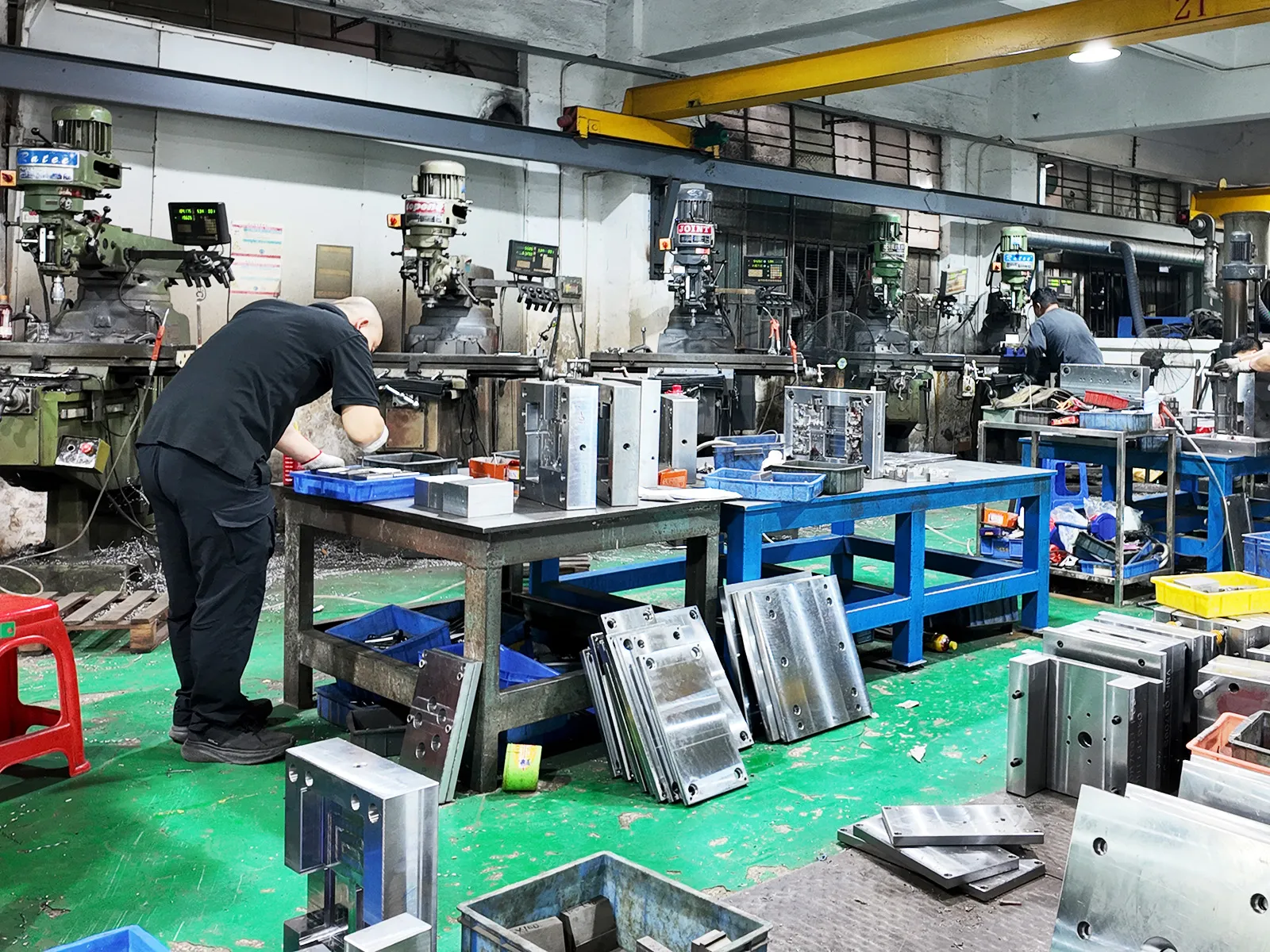
Why Material Choice Is Especially Tricky for Figure Manufacturing
A PVC figure is rarely a single-material object. A typical twelve-centimeter character might have an ABS torso frame, a slush-molded soft PVC head, PA gears inside the hip joint, and a PMMA visor over the eyes. The injection-molded hard parts and the slush-molded soft parts are usually made from different resins and on different production lines. That layering of materials means the mechanical engineer worrying about joint tightness needs different material properties than the painter worrying about adhesion. The QC inspector checking drop-test results needs different properties than the accountant checking cost per unit. A good material specification balances all of those demands simultaneously.
Material 1 — ABS (Acrylonitrile Butadiene Styrene)
ABS is the workhorse of injection-molded PVC figure parts. It processes easily, holds fine detail, takes plating well, and arrives at the factory in a form stable enough to handle without drama. Toy parts destined for electroplating — chrome-look accents, mirror-finish belt buckles, decorative armor panels — are almost always ABS. The butadiene component gives the material its signature toughness; the acrylonitrile gives it chemical resistance; the styrene gives it rigidity and the surface quality that plating requires.
Processing behavior: ABS has a melt temperature around 170°C and a decomposition threshold around 260°C, giving operators a reasonable working window. Barrel temperatures typically run 180–240°C, with 220–250°C being the sweet spot for most grades. One detail that catches newcomers: above the optimal processing range, instead of flowing more easily, ABS actually becomes harder to inject — the rubber phase degrades, melt viscosity increases, and the fill gets worse. Drying is critical: ABS absorbs moisture, and moisture in the barrel produces silver streaks, surface fogging, and bubbled parts. The protocol is 75–80°C for 2–3 hours in dry seasons, 80–90°C for 4–8 hours during humid summer months. Key numbers: shrinkage approximately 0.5%, flash limit 0.05 mm, mold temperature 75–85°C. Regrind is acceptable up to 30% for standard grades; plating-grade ABS uses virgin material only.
Material 2 — PC (Polycarbonate)
PC is the engineering plastic of the group — higher cost, higher performance, higher demand for process discipline. Its impact resistance is roughly fifteen times that of ABS; its optical clarity rivals glass; its heat resistance extends to 120°C or above. For a PVC figure that includes transparent windows, visors, or lens elements, PC is usually the only credible choice. But it punishes process errors in ways that ABS and PP do not.
PC has no sharp melting point. It starts to soften around 220°C and processes in the range of 270–320°C — a window that sounds wide but is operationally narrow because PC oxidizes and turns yellow above 340°C and becomes very difficult to fill below 270°C. Unlike ABS, where raising injection pressure compensates for borderline temperatures, PC's melt viscosity is almost insensitive to pressure but highly responsive to temperature. If a part is underfilling, the correct fix is almost always higher barrel temperature or mold temperature, not higher injection pressure. Drying is extremely strict: moisture content must stay below 0.02% — roughly ten times stricter than ABS. Standard protocol is 120°C for 4–5 hours before molding. Molded PC parts carry significant residual stress, particularly around gates and sharp corners, leading to stress-cracking that often appears days or weeks after production. Mold temperature of 80–100°C is the principal tool for managing this stress. Key numbers: shrinkage 0.5%, injection pressure 80–120 MPa, regrind maximum three cycles at under 20% blend ratio.
Material 3 — PVC (Polyvinyl Chloride, Rigid Compound)
The name "PVC figure" comes from PVC — specifically from the slush-molded soft PVC that gives hollow character bodies their squeezable texture. But rigid PVC shows up in injection-molded components too: shoes, accessories, rigid decorative elements, and any part where the client wants the dimensional precision of injection molding combined with PVC's characteristic surface feel. Hard injection-grade PVC is not a single material. It is a compound: PVC resin as the base, with plasticizers, heat stabilizers, lubricants, fillers, and colorants. Each change in compound formulation changes the processing behavior, so the molder cannot treat PVC as a fixed material the way they treat virgin ABS or PC.
PVC's thermal window is uniquely narrow. It starts to melt at 120–145°C; it starts to release hydrogen chloride (HCl) gas below 150°C; at 180°C the HCl release becomes heavy and continuous. Processing temperatures run 140–190°C, meaning the working range above decomposition onset is extremely tight. Short injection cycles, low barrel residence times, and frequent barrel purges are not best practices — they are production requirements. Released HCl corrodes mold surfaces; regular cleaning of cavities and runner dead zones is mandatory. Because PVC melt viscosity is very high and flow length short, gates and runners must be oversized. Wall thickness should not go below 1.5 mm. Injection pressure runs high: 150–200 MPa or above. Whenever the designer calls for a rigid element that visually and tactilely matches the PVC body, hard PVC avoids the visible material-change line that appears when PVC and ABS are assembled together.
Material 4 — PA (Polyamide / Nylon)
PA — the chemical family behind every variety of nylon — is not a PVC figure material in the visual sense. Nobody specifies PA for a visible torso panel or a decorative chest emblem. PA goes where strength, wear resistance, and dimensional stability under load matter more than appearance: gears, bearings, axles, hip joint pins, articulation connectors. In a poseable PVC figure, the ratchet joints that hold a limb in position are usually nylon. These are parts that are cycled thousands of times by a child; they need to survive that use without galling, deforming, or cracking.
PA is crystalline, has a sharp melting point, and flows very freely in the molten state — a thin, fast-moving melt that requires self-locking or nylon-specific nozzle tips to prevent drool. PA parts are usually run on a dedicated press because the nozzle tip and screw design differ from those used for ABS or PC. Drying is critical: PA is aggressively hygroscopic, with standard pre-drying at 120°C for 3–4 hours. Nylon that has sat in an open hopper overnight should be re-dried before use, regardless of how dry the storage room seems. For a factory in southern China, where summer humidity routinely exceeds 80%, nylon drying discipline is one of the most critical process controls on the floor. PA has higher and more anisotropic shrinkage than ABS or PC — PA6, PA6/6, PA12, and glass-filled variants all shrink differently. A PVC figure with tight joint tolerances requires careful PA grade specification from the start, because changing the grade mid-project means re-cutting the mold.
Material 5 — PMMA (Polymethyl Methacrylate / Acrylic)
PMMA is optical glass in plastic form. Relative density 1.19; surface gloss higher than PC at the same process conditions; transparency comparable to optical glass; hardness that resists scratching better than PC. In a PVC figure application, PMMA shows up in display-quality clear elements where the primary demand is visual clarity rather than impact toughness. Its saving grace as a process material is a wide temperature window: softening at 160°C, free-flowing at 180°C, decomposition at 270°C, giving operators a 90-degree working range versus PC's much narrower window. Both temperature and injection pressure improve filling; unlike PC, where temperature is the dominant lever, PMMA responds to both.
PMMA's weakness is impact resistance and surface scratch resistance. It chips on sharp edges; it scratches easily; it crazes under sustained stress. In PVC figure production, PMMA parts are usually designed as inserts or decorative overlays, not structural elements. A clear PMMA visor that sits inside an ABS frame is fine; a PMMA structural bracket under load is a liability. Pre-drying at 100°C for 2–3 hours is standard. Unlike PA or PC, PMMA drying is not a critical process gate — but skipping it still produces surface defects on clear parts, and those defects are impossible to hide on a transparent lens.
A Decision Framework for PVC Figure Materials
Choosing the right material for each component is a layered set of trade-offs across function, appearance, cost, and process. For structural parts that bear mechanical load: ABS for high-impact visible elements, PC for transparent high-impact parts, and PA for moving, sliding, or rotating internal components. For decorative parts: ABS (plating grade) if the element will be electroplated, PMMA or PC for clear elements, and hard injection-grade PVC to match adjacent soft PVC in surface and color. When cost is the driving constraint, PP (polypropylene) is the budget choice for hidden body parts — it is cheaper than ABS, adequate for many toy applications, and processes easily. And when the part will face chemical exposure from paints, primers, or solvents during finishing, a brief review of the specific solvent system with the material supplier avoids adhesion failures downstream.
The Real Cost of Material Choice
Material cost is not just the price of pellets. Every resin comes with its own drying time (energy and machine time), its own cycle time in the barrel, its own scrap rate during start-up, and its own tooling requirements. PA requires the tightest tool tolerances of the five materials. PC demands the most rigorous drying and generates the most frequent purging waste. PMMA, despite being visually spectacular, is among the most brittle — which means higher breakage rates during assembly and higher packaging requirements. A PVC figure that calls for PC lenses, PA joints, and plating-grade ABS panels will cost significantly more to manufacture than one built from standard ABS and PP throughout — and the cost gap is not just in the pellets. Tooling cost for PVC and PA runs higher than for ABS. Drying cost for PC and PA adds machine hours that ABS does not require. Scrap rates during color-change purges are higher for PVC than for any other resin on the list.
Process Discipline: Where Most Projects Fail
Most material-related failures on a PVC figure line are not caused by picking the wrong resin. They are caused by skipping the drying step, running the barrel too hot, or mixing regrind at too high a ratio. ABS runs fine on a dry hopper. PA and PC demand continuous drying and sealed transfer. PVC demands short residence times and frequent purges. PMMA demands careful part design to avoid stress concentration. Each material has its own discipline requirements, and the factory floor supervisor who enforces those requirements consistently is the single most important quality gate in PVC figure manufacturing. The five materials covered here — ABS, PC, PVC (rigid), PA, and PMMA — are not exotic engineering plastics. They are standard commodity resins available globally. What makes material selection challenging is the intersection of multiple materials in a single product, each requiring different processing conditions, different tooling assumptions, and different quality criteria.
Getting that intersection right is the work of early-stage collaboration between the designer who specifies the part, the mold engineer who builds the tool, and the process technician who runs the machine. Do that collaboration properly and the material decisions look obvious in hindsight. Skip it, and the problems show up in the finished product — in the cracked joint, the foggy lens, and the plating that peels off on the way to the shelf. The best PVC figure is the one where material selection was solved before the first mold was cut, not after the first production run failed QC.