
Inside a Custom Vinyl Figure Manufacturer: How PVC Becomes a Collectible
Walk into a custom vinyl figure manufacturer's workshop and the first thing that hits you is the heat. Not the dry, office-building kind — this is a wet, heavy heat rolling off furnaces running north of 250°C. The second thing is the smell: warm plastic and something faintly chemical, like nail polish in a sauna. The third is the rhythm. Every few minutes a worker pulls a spinning rack of copper molds out of a furnace, dips it in water, pops it open, and yanks out a floppy, hollow vinyl head still too hot to hold bare-handed. That's rotocasting — the signature process of any custom vinyl figure manufacturer.
It Starts With Sludge
A custom vinyl figure manufacturer doesn't begin with solid plastic pellets the way an injection molding shop does. Rotocasting starts with a liquid — a sludgy, colorful paste called PVC plastisol. Making that paste is an art in itself, one that separates a good custom vinyl figure manufacturer from a bad one. The base is PVC powder, but a custom vinyl figure manufacturer blends in a whole chemistry set of additives before anything gets near a mold. Plasticizers — usually DINP oil — go in to make the final product soft and flexible. A secondary plasticizer called TXIB can be added in smaller amounts (10–20% of the total plasticizer) to thin the mix and shorten curing time, though it's volatile and pricey, so you don't overdo it.
Stabilizers get mixed in to prevent the PVC from degrading under heat — without them, the material breaks down, releases hydrochloric acid, and turns black. Anti-heat oil boosts color fastness. A release agent keeps the cured part from sticking to the mold. And then there's the colorant: pigment dispersed in plasticizer, ground on a three-roll mill until it's perfectly smooth. Every custom vinyl figure manufacturer guards their exact formulation — the ratio of PVC powder to oil determines hardness. More oil, softer product. Less oil, firmer. The colorant blend is another secret — getting a consistent flesh tone or a specific Pantone match across production runs is harder than it sounds.
The mixing procedure itself is painstaking. Add the oils and stabilizers first, then the PVC powder in stages, then the colorant. Slow stir for 15 minutes. Scrape the blades. Add more powder and oil. Slow stir again. Then fast stir for 40 minutes while pulling vacuum — the mixing tank has to hit a vacuum reading of at least 25 inches of mercury. That vacuum is what pulls trapped air and moisture out of the paste. Skip it, and your finished parts come out riddled with bubbles — a defect no custom vinyl figure manufacturer can afford to ship.
The Furnace: 250 Degrees of Controlled Chaos
Once the paste is ready, the actual rotocasting begins — the core production step at any custom vinyl figure manufacturer. A worker fills each copper mold with a measured amount of plastisol using a dispensing gun. The quantity is precise — every part has a target weight, and overfilling means a thick, heavy piece that's hard to work with later. Underfilling means thin walls, weak spots, and parts that tear during demolding.
The filled molds get locked shut, loaded onto a circular metal rack (called a plate), and pushed into the rotocasting furnace. Here's where the magic happens at a custom vinyl figure manufacturer: the entire rack spins 360 degrees while the furnace heats it to 250–280°C. As the rack tumbles, the liquid plastisol coats the inside of every mold evenly. Gravity and centrifugal force do the distribution work — no cores, no injection pressure, just rotation and heat. After about two minutes, the PVC cures into a solid shell against the mold wall.
A custom vinyl figure manufacturer typically runs three plates per furnace in a staggered cycle. While two plates are inside curing, the third is outside — getting cooled in a water tank, having finished parts pulled out by hand, and being refilled with fresh paste. Each cycle takes 180 to 240 seconds, so a single furnace can kick out parts every three to four minutes. The math works like this: say a custom vinyl figure manufacturer has 12 molds per plate, a 240-second cycle, and runs 22 hours a day. That's 15 cycles per hour, 330 cycles per day, and 3,960 parts per furnace per day — not bad for a process that looks almost medieval compared to high-speed injection molding.
Pulling the Part Out — By Hand
Here's something most people don't realize about rotocasting at a custom vinyl figure manufacturer: demolding is manual. A custom vinyl figure manufacturer doesn't use ejector pins or robotic arms. A worker opens the mold, peels back the flash at the fill opening to vent hot air, and then physically yanks the part out of the mold by hand. This works because cured PVC is flexible. You can stretch and deform it to pull it past undercuts, around corners, and through narrow neck openings that would be impossible with rigid injection-molded parts. It's the same reason a custom vinyl figure manufacturer can produce hollow heads with interior details — the part just folds and pops out.
But it takes skill — and this is where a custom vinyl figure manufacturer's experience really shows. Pull too hard and you tear the part or leave a permanent crease. Pull unevenly and the part warps. Grab the mold with pliers and you'll scratch the copper surface — a mistake no custom vinyl figure manufacturer can afford, since every future part from that mold will carry the mark. After demolding, some parts are warped from the thermal shock. They go into a re-shaping oven at around 100°C for 20 minutes to relax back into their correct form. Then someone trims off the flash — the thin lip of excess PVC left at the mold seam — with a small knife. It's tedious, fiddly work, and doing it carelessly leaves visible nicks on the finished part.
The Mold: Electroplated Copper, Built in Stages
The molds themselves are a big part of what makes a custom vinyl figure manufacturer different from other plastic processors — and one of the biggest investments. Rotocasting molds are made of copper — or more precisely, copper electroplated over a wax master. A sculptor creates a clay prototype from the design drawings. Once approved, a silicone negative is taken from the clay. Wax gets poured into the silicone to create a wax master, which is about 8% larger than the final part (to account for shrinkage). That wax master goes into an electroplating bath where copper builds up on its surface, forming a shell. Once the wax is melted out, you have a copper mold — the master mold.
But one mold isn't enough for production. A custom vinyl figure manufacturer needs dozens, sometimes hundreds, of identical molds. So the master mold gets used to rotocast a batch of "master skins" — thin PVC shells that are about 6% larger than the final product. Those skins go back into the electroplating bath to create the production molds, which end up about 3% oversized. The final shrinkage happens during curing. There's also a wrinkle: bare copper reacts with PVC at high temperatures, releasing toxic copper chloride and discoloring the parts. So every copper mold gets a thin nickel plating on the inside. That nickel layer wears down over time, so a custom vinyl figure manufacturer has to periodically re-plate the molds.
Spraying: The Paint Job That Makes or Breaks the Figure
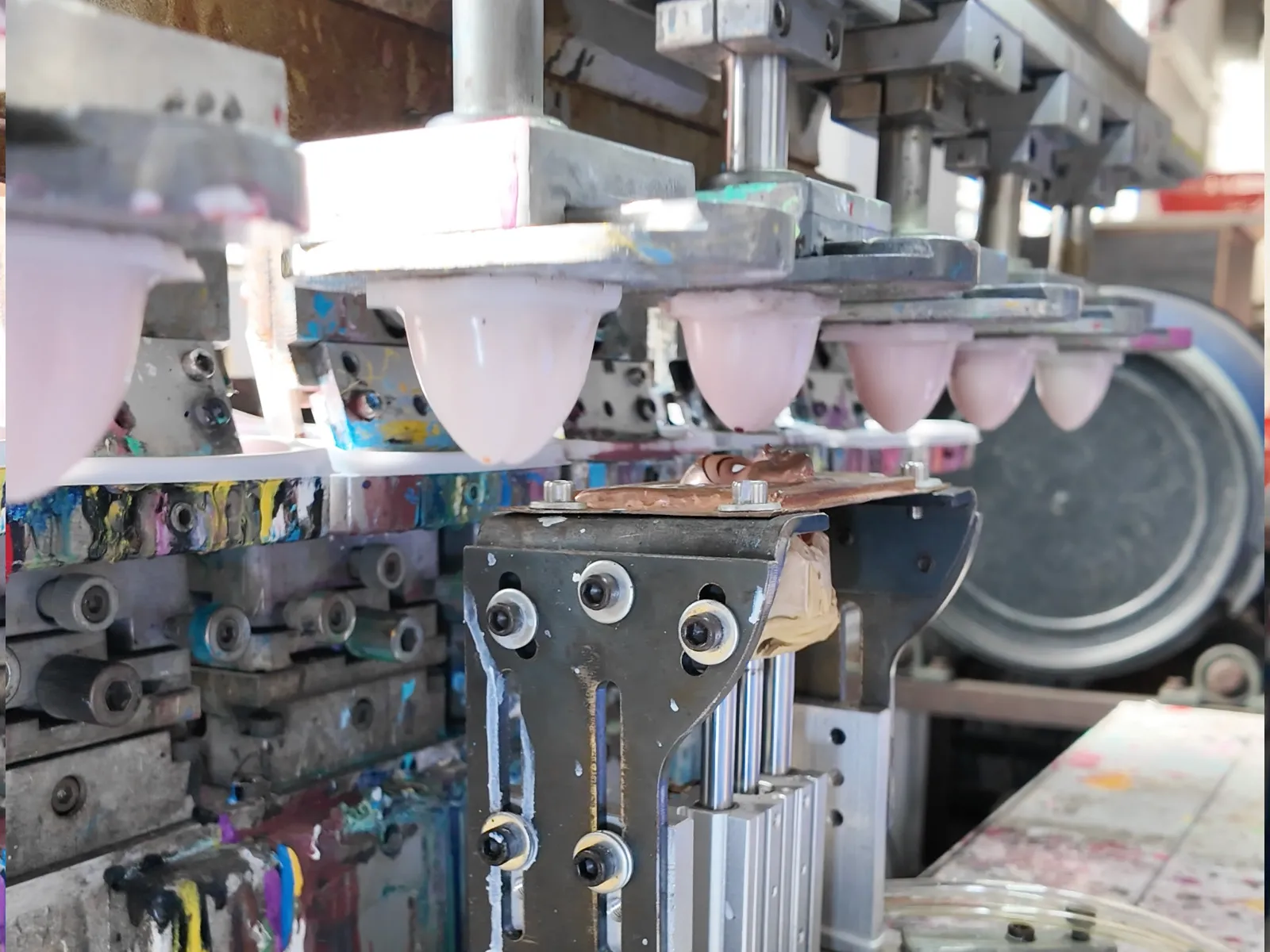
A bare rotocast part is called a "blank" — just a flesh-colored or white vinyl shell. Nobody puts a blank on a shelf. What turns it into something worth displaying is the surface decoration, and at a custom vinyl figure manufacturer, the first step is almost always spray painting. Workers use compressed-air spray guns, operated by hand. They hold a paint mask (a jig that covers areas that shouldn't be painted) against the part, squeeze the trigger, and lay down a coat. It sounds simple. It isn't.
The paint has to match the substrate — a lesson every custom vinyl figure manufacturer learns the hard way. Soft PVC and rotocast parts need soft-paint formulations — vinyl acetate coatings — because hard acrylic paint on a soft surface will crack when you squeeze the figure. Conversely, you can use soft paint on hard plastic, but not the reverse. Getting this wrong is one of the fastest ways a custom vinyl figure manufacturer can lose a client — the paint either peels off in sheets or turns sticky and never cures. Paint formulation is another closely guarded secret. A typical soft-PVC white paint might contain cyclohexanone (to soften the vinyl surface for adhesion), MEK (to speed evaporation), toluene (to dissolve the resin), and various resin powders. Overspray is a real problem — you're lucky to get 50–60% paint utilization on large parts, and as little as 15–30% on small pieces.
Hair: Stitched In, One Strand at a Time
For doll-style figures, the next stop after painting at a custom vinyl figure manufacturer is the hair department. And yes, a custom vinyl figure manufacturer literally stitches hair into the vinyl head using a sewing machine. The process is called "rooting" — a specialized sewing machine with a curved needle drives bundles of nylon or polypropylene fiber through the vinyl scalp, looping them around a base thread to lock them in place. Needle selection matters: thinner needles (size 70–80) for small heads, thicker ones (size 120–140) for large heads. The wrong needle tears the vinyl or leaves visible holes. And every so often a needle snaps during operation, leaving a fragment buried inside the head. That's why every finished figure goes through a metal detector before packing.
After rooting, the hair gets oven-set at 70–80°C for 25–45 minutes or steamed at 105–125°C to lock in the style. A custom vinyl figure manufacturer then has a worker trim and comb the hair by hand — literally giving the figure a haircut, using regular scissors, following a reference sample. It's one of the most labor-intensive steps in the entire workflow.
Why Custom Vinyl Figure Manufacturing Is Expensive
Put it all together — the hand-mixed paste, the electroplated molds, the manual demolding, the hand-sprayed paint, the hand-rooted hair, the individual haircuts — and you start to understand why a custom vinyl figure manufacturer charges what they do. Rotocast waste can't be recycled, unlike injection molding where runner scrap gets ground up and fed back into the machine. The raw materials are more expensive, too — plastisol formulations cost more per kilogram than injection-molding pellets. Molds have shorter lifespans because of nickel-plating wear. And every step requires skilled hands, not just machine operators — labor cost is a major line item.
That's why rotocasting is mostly found in mid-range to premium products. Limited-edition art toys, movie tie-in collectibles, designer figures — these are the bread and butter of any custom vinyl figure manufacturer. But there are things rotocasting can do that injection molding simply can't. Hollow parts with uniform wall thickness. Soft, squeezable figures with a tactile quality that rigid plastic can't match. Undercut details that would require complex side-action cores in injection molding but just peel out of a rotocast mold. For a custom vinyl figure manufacturer serving collectors and artists, those qualities are worth every penny of the added cost.
What to Look For When Choosing a Custom Vinyl Figure Manufacturer
If you're a designer or brand looking to work with a custom vinyl figure manufacturer, here are the things that separate a good one from a mediocre one. First, mold quality: ask how they handle nickel re-plating and mold maintenance — a manufacturer that can't tell you their re-plating schedule is probably running molds past their useful life. Second, paste consistency: request sample parts from different production runs and check the color, hardness, and wall thickness — inconsistent plastisol mixing is the number one cause of quality variation. Third, paint adhesion: do a tape test — press adhesive tape onto a painted surface and pull it off; if paint comes with it, the manufacturer has a formulation or surface-prep problem.
Fourth, metal detection: every rooted-hair figure should pass through a metal detector before packing — no exceptions. If a manufacturer skips this step, find another supplier. Fifth, communication: rotocasting involves a lot of hand work and subjective quality judgments — working with a manufacturer that sends you clear photos of sample issues and asks for direction will save you far more time than one that guesses and ships. The vinyl figure market keeps growing — art toys, blind boxes, licensed collectibles, custom commissions. Behind every one of them is a custom vinyl figure manufacturer's workshop where someone mixed paste by formula, spun a mold in a furnace, pulled a hot vinyl shell out by hand, sprayed it with carefully matched paint, and maybe even gave it a haircut. It's a craft as much as it's manufacturing, and the best custom vinyl figure manufacturer is the one that treats it that way.