
EU Toy Safety Regulation (TSR) Explained — What Custom Toy Makers Must Know
If you design, manufacture, or import custom toys — blind box figures, vinyl art toys, PVC action figures, resin statues, plush keychains — and sell them into the EU market, the TSR rewrites the rulebook. Regulation (EU) 2025/2509 upgrades the old Toy Safety Directive (2009/48/EC) into a directly binding regulation, introduces the Digital Product Passport, bans entire chemical families like PFAS, slashes BPA migration limits by a factor of eight, and extends chemical restrictions that once applied only to under-3 toys to all toys for children under 14. The transition window runs until August 2030 — but waiting until 2029 will cost far more than starting now.
Full legal name: Regulation (EU) 2025/2509 of the European Parliament and of the Council of 26 November 2025 on the safety of toys and repealing Directive 2009/48/EC (Text with EEA relevance)
Short name: TSR (Toy Safety Regulation)
Legal form: Regulation — directly applicable in all EU Member States without national transposition
Source:EUR-Lex Official Journal
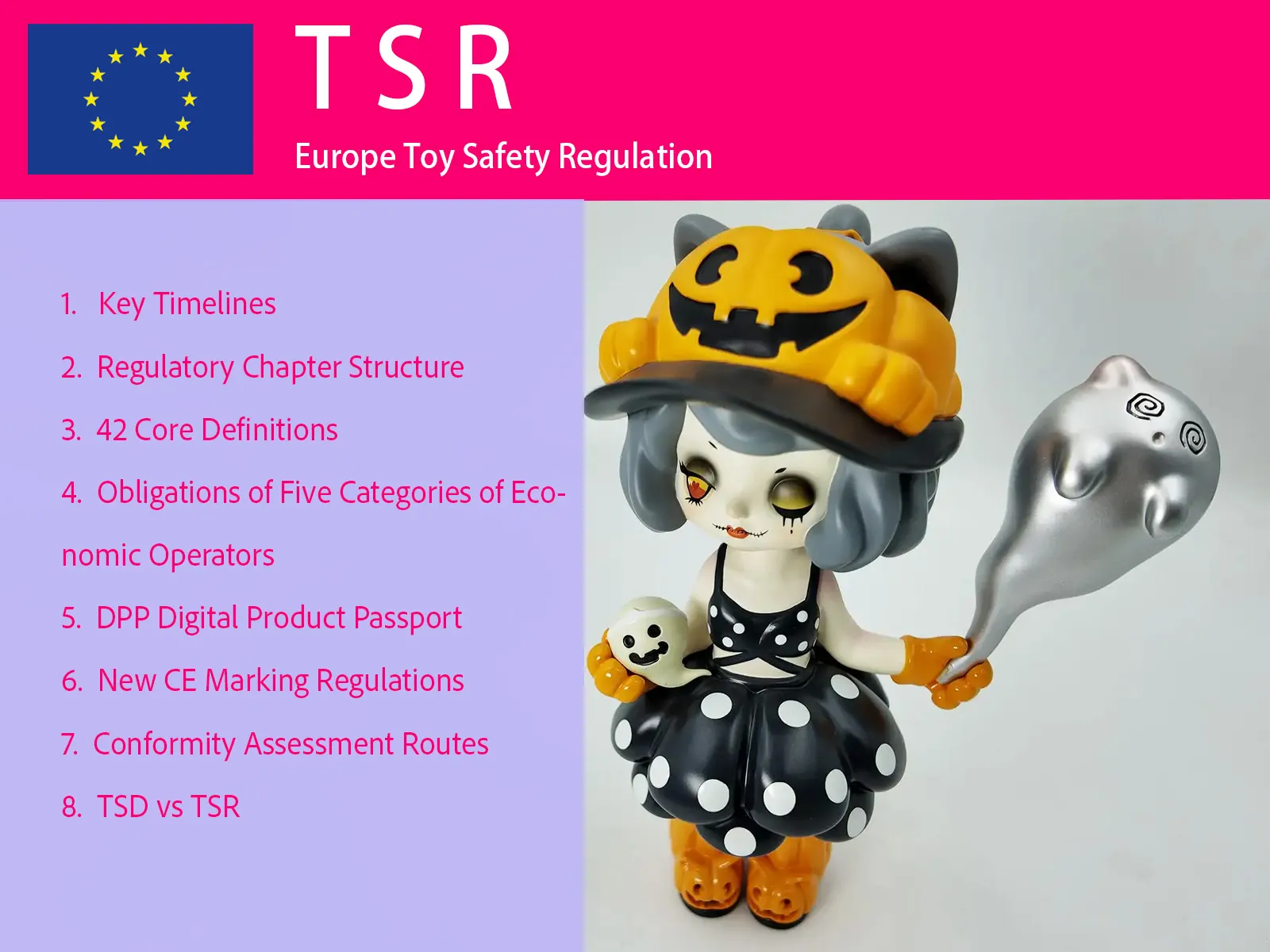
Why This Matters for Custom Toy Businesses
This is not a minor update. It upgrades the old Toy Safety Directive (2009/48/EC) into a directly binding Regulation, introduces the Digital Product Passport, bans entire chemical families like PFAS, slashes BPA migration limits by a factor of eight, and extends chemical restrictions that once applied only to under-3 toys to all toys for children under 14. The transition window is generous — manufacturers have until 1 August 2030 — but the scope of change is large enough that waiting until 2029 will cost more than starting now.
Key Dates
| Date | Event |
|---|---|
| 26 November 2025 | Adopted by the European Parliament and Council |
| 12 December 2025 | Published in the Official Journal of the EU |
| 1 January 2026 | TSR enters into force; Directive 2009/48/EC begins phase-out |
| 2026–2030 | Transition period — toys compliant with the old Directive can still be placed on the market |
| 1 August 2030 | Full mandatory application; Directive 2009/48/EC fully repealed |
Practical impact: Any new mold opened today for an EU-bound product should be designed against TSR requirements, not TSD. Retrofitting a chemistry bill of materials in 2029 is far more expensive than getting it right from the first PVC compound.
Regulation Structure at a Glance
Chapters
| Chapter | Title | Articles |
|---|---|---|
| I | General Provisions | 1–6 |
| II | Obligations of Economic Operators | 7–13 |
| III | Obligations of Online Marketplace Providers | 14 |
| IV | Conformity of Toys | 15–18 |
| V | Digital Product Passport | 19–24 |
| VI | Conformity Assessment | 25–27 |
| VII | Notification of Conformity Assessment Bodies | 28–44 |
| VIII | Market Surveillance | 45–48 |
| IX | Delegated Powers and Committee Procedure | 49–53 |
| X | Confidentiality and Penalties | 54–55 |
| XI | Final Provisions | 56–59 |
Annexes
| Annex | Content |
|---|---|
| Annex I | Products excluded from the Regulation |
| Annex II | Specific safety requirements |
| Annex III | Warning categories and rules |
| Annex IV | Conformity declaration |
| Annex V | Conformity assessment |
| Annex VI | Digital Product Passport information content |
| Annex VII | Compliance related |
| Annex VIII | Compliance related |
Scope and Key Definitions (Chapter I)
The TSR applies to products designed or intended, whether or not exclusively, for use in play by children under 14 years of age. The determining factor: if a parent or supervisor would reasonably consider, based on the product's functions, dimensions and characteristics, that it is designed for play by children of a given age group, it falls within scope. Products listed in Annex I are excluded.
Key Definitions (Article 3)
| # | Term | Definition |
|---|---|---|
| (1) | making available on the market | Supplying a toy for distribution, consumption or use on the Union market, whether for payment or free of charge |
| (2) | placing on the market | The first making available of a toy on the Union market |
| (3) | manufacturer | Any natural or legal person who manufactures a toy, or has a toy designed or manufactured, and markets it under their name or trademark |
| (4) | authorised representative | Any natural or legal person established in the Union who has received a written mandate from a manufacturer |
| (5) | importer | Any natural or legal person established in the Union who places a toy from a third country on the Union market |
| (8) | economic operator | The manufacturer, authorised representative, importer, distributor and fulfilment service provider collectively |
| (13) | CE marking | A marking by which the manufacturer indicates that the toy complies with applicable Union harmonisation legislation |
| (14) | essential safety requirements | The general safety requirement (Article 5(2)) plus the specific safety requirements (Annex II) |
| (15) | toy model | A group of toys sharing: same manufacturer, uniform design/technical characteristics, uniform materials/manufacturing processes, identifiable as a group |
| (17) | digital product passport (DPP) | A set of data specific to a given toy, containing the information specified in Annex VI, accessible electronically via a data carrier |
| (18) | unique product identifier | A unique string of characters for the identification of a product |
| (19) | unique operator identifier | A unique string of characters for the identification of an economic operator |
| (25) | conformity assessment | The process demonstrating whether the essential safety requirements have been met |
| (31) | recall | Any measure aimed at achieving the return of a toy already made available to the end-user |
| (32) | withdrawal | Any measure aimed at preventing a toy in the supply chain from being made available on the market |
Toy Category Definitions
| # | Term | Definition |
|---|---|---|
| (35) | functional toy | A toy that functions and is used in the same way as a product, appliance or installation intended for use by adults, and may be a scale model |
| (36) | aquatic toy | A toy designed for use in shallow water, capable of carrying or supporting a child on water |
| (37) | activity toy | A toy for domestic use where the supporting structure remains stationary — climbing, jumping, swinging, sliding, rocking, spinning, crawling |
| (38) | chemical toy | A toy intended for the direct handling of chemical substances and mixtures |
| (40) | cosmetic kit | A toy intended to help children learn to make cosmetics such as perfumes, soaps, creams, shampoos, lip gloss, lipstick, nail varnish |
| (41) | gustative game | A toy allowing children to make sweets or dishes using food ingredients including liquids, powders and spices |
| (42) | PFAS | Any substance containing at least one fully fluorinated methyl (CF₃–) or methylene (–CF₂–) carbon atom |
Obligations of Economic Operators (Chapter II)
Obligations of Manufacturers (Article 7)
Before placing a toy on the market, the manufacturer must: design and manufacture in compliance with essential safety requirements; prepare technical documentation and carry out the conformity assessment procedure; create a Digital Product Passport; affix a data carrier and the CE marking; and upload the unique product identifier, unique operator identifier and other required information to the DPP registry.
After placing on the market: keep technical documentation and the DPP for 10 years; ensure series production remains compliant through sample testing; mark the toy with type, batch, serial number or model number; indicate the manufacturer's name, registered trade name or trademark, postal address and email address; provide instructions and safety information in a language easily understood by consumers; when non-compliance is discovered, immediately take corrective measures and notify market surveillance authorities via the Safety Business Gateway; notify consumers and end-users of any risk; maintain a public communication channel for safety complaints; and investigate complaints while keeping internal records.
Cross-cutting obligations: Toys with AI functionality requiring third-party conformity assessment are classified as high-risk AI systems under Regulation (EU) 2024/1689. Connected toys with social interaction or location tracking are classified as important products with digital elements (Class I) under Regulation (EU) 2024/2847. Radio-equipped toys must comply with cybersecurity requirements under Directive 2014/53/EU. Manufacturers must assess the impact of connected digital toys on children's mental health and cognitive development.
Obligations of Importers (Article 9)
Only place compliant toys on the market. Ensure the manufacturer has carried out the conformity assessment procedure. Indicate the importer's name and contact address on the toy (or on packaging/accompanying documents if size prevents). Ensure the toy is accompanied by instructions and safety information in the language determined by the Member State. Keep compliance documentation for 10 years.
Obligations of Distributors (Article 10)
Act with due care to ensure handling does not jeopardise compliance. Do not make available non-compliant toys. Cooperate with national authorities on market surveillance.
Obligations of Online Marketplace Providers (Article 14)
Offers of non-compliant toys are considered illegal content under Regulation (EU) 2022/2065, triggering specific due diligence obligations for online intermediary service providers.
Conformity and CE Marking (Chapter IV)
Presumption of Conformity
Toys conforming to harmonised standards published in the Official Journal are presumed compliant with essential safety requirements. Where no harmonised standard exists, the Commission may adopt common specifications via implementing acts.
CE Marking (New Requirements)
CE marking must now appear on both the toy and the packaging. If affixing to the toy is impossible (e.g., counter display), it must appear at the point of display. The CE mark must be followed by a safety icon or other safety information.
Digital Product Passport (DPP, Chapter V)
This is the single biggest structural change. The old Declaration of Conformity is replaced by a machine-readable digital passport.
| Aspect | Requirement |
|---|---|
| Data carrier | Must be physically attached to the toy or its label; if too small, may be on packaging but visible at point of sale (including online) |
| Uniqueness | Each data carrier must be unique per toy |
| Consumer access | No download, registration, or password required |
| Data ownership | DPP data stored by the operator responsible; other operators may not sell or reuse such data |
| Registry upload | Unique product identifier and operator identifier must be uploaded before placing on the market |
| Customs integration | Customs authorities can automatically verify the DPP via the EU CSW-CERTEX system |
For custom toy makers: The DPP is not optional. If you ship custom blind box figures or vinyl art toys to the EU, each SKU needs its own data carrier and registry entry. Plan this into your packaging design and IT workflow now.
Conformity Assessment Routes
| Situation | Procedure |
|---|---|
| Manufacturer has followed harmonised standards covering all safety requirements | Internal production control (Module A — self-declaration) |
| No such harmonised standards or common specifications exist | EU type-examination (Module B — third-party verification) |
| Manufacturer considers third-party verification necessary | EU type-examination |
Most standard PVC figures, blind box toys, and plush items using established materials will fall under Module A — but only if you actually follow the applicable harmonised standards. Novel materials (bio-based resins, glow pigments, scented compounds) may trigger Module B.
Physical and Marking Changes (TSR vs. TSD)
| Under TSD (2009/48/EC) | Under TSR (EU) 2025/2509 |
|---|---|
| Directive — required national transposition | Regulation — directly applicable in all Member States |
| EU Declaration of Conformity (DoC) | Digital Product Passport (DPP) |
| CE marking on toy only | CE marking on toy + packaging; if impossible, at point of display; followed by safety icon |
| Text-only warning prefix | Warning may start with "Warning" or a 10 mm triangle pictogram |
| — | Toys with batteries: batteries accessible only with a tool |
Chemical Requirements (Massively Strengthened)
The TSR introduces the most significant chemical safety upgrade in EU toy regulation history. Five new hazard categories are now banned: endocrine disruptors (Categories 1 and 2), specific target organ toxicity (Category 1), respiratory sensitisers (Category 1), and skin sensitisers (Category 1A). These join the existing ban on CMR substances (Categories 1A, 1B, 2).
Changed Migration and Content Limits
| Substance | TSD Limit | TSR Limit | Scope Change |
|---|---|---|---|
| Bisphenol A (BPA) | 0.04 mg/L | 0.005 mg/L (8× stricter) | Extended to all toys under 14 |
| TCEP / TCPP / TDCP | Under-36-months only | All toys under 14 | Scope expanded |
| Formamide | Under-36-months only | All toys under 14 | Scope expanded |
| BIT / CMI (isothiazolinones) | Under-36-months only | All toys under 14 | Scope expanded |
| Phenol / Formaldehyde / Aniline | Under-36-months only | All toys under 14 | Scope expanded |
This scope expansion is the single most impactful change. If you make PVC figures, blind box toys, or vinyl art toys for ages 6+, you previously did not need to test for BPA/formamide/phenol limits. Under TSR, you now do. Every existing compound needs re-evaluation.
New Migration Limits for Monomers
| Monomer | TSR Migration Limit | Common Source |
|---|---|---|
| Acrylonitrile | 0.01 mg/L | ABS resin |
| Butadiene | 0.07 mg/L | ABS resin |
| Styrene | 0.77 mg/L | Polystyrene, ABS |
| Vinyl chloride (VC) | 0.01 mg/L | PVC resin |
These are monomers commonly found in ABS, PVC, and polystyrene — the backbone materials of most plastic toys. If your PVC compound supplier cannot certify these limits, you need a new supplier.
PFAS (Blanket Ban)
The intentional use of PFAS is banned in toys, toy components, or microstructurally distinct toy parts. This covers PTFE coatings, fluorinated mold-release agents, water-repellent fabric treatments, and any perfluorinated additive. Bisphenols face a similarly expanded ban: where TSD only regulated BPA, TSR bans 10 bisphenols immediately, with a pathway to expand to 34 — the full ECHA-identified group found to interfere with the endocrine system and affect reproduction.
Fragrance Allergens and Heavy Metals
| Item | TSD | TSR |
|---|---|---|
| Fragrance allergen labelling threshold | 100 mg/kg (0.01%) | 10 mg/kg (0.001%) — 10× stricter |
| Heavy metals (As, Cd, Cr VI, Pb, Hg, Organotin) | — | Limit values at half the level considered safe by the relevant scientific body |
| Nitrosamines (slime/putty) | — | 0.02 mg/kg; nitrosatable substances: 1 mg/kg |
The ALARA Principle and Exemptions
Prohibited substances are acceptable only at trace levels where their presence is technically unavoidable under good manufacturing practice, the toy is safe, and the ALARA principle (As Low As Reasonably Achievable) is followed. A prohibited substance may be exempted if it is safe for children, no suitable alternative exists, and its use has not been prohibited under REACH. ECHA is responsible for evaluating substance safety and alternative availability.
Market Surveillance & Penalties (Chapter VIII)
Market surveillance falls under the framework of Regulation (EU) 2019/1020, using Regulation (EU) 2023/988 for the Safety Gate rapid alert system and Safety Business Gateway. The safeguard procedure allows the Commission and other Member States to review the justification of national measures against non-compliant toys. Market surveillance authorities must communicate findings via the information and communication system.
Under Article 55, Member States must lay down penalty rules for infringements. Penalties must be effective, proportionate and dissuasive.
What Must Appear on Every Toy
- ●Type, batch, serial number or model number
- ●Manufacturer name, trademark, postal address, email address
- ●CE marking (toy + packaging)
- ●Data carrier (DPP access point)
- ●Warnings (beginning with "Warning" or a 10 mm triangle pictogram)
- ●Instructions and safety information (in the language determined by the Member State)
- ●Documentation retention period: 10 years
Cross-References to Other EU Legislation
| Legislation | Relevance to Custom Toys |
|---|---|
| Regulation (EU) 2023/988 (GPSR) | Supplements sector-specific rules; covers online sales and Safety Gate |
| Regulation (EU) 2024/1689 (AI Act) | Toys with AI safety components classified as high-risk AI systems |
| Regulation (EU) 2024/2847 (Cyber Resilience Act) | Connected toys with social interaction or tracking as Class I digital products |
| Directive 2014/53/EU (RED) | Radio-equipped toys must comply with cybersecurity requirements |
| Regulation (EC) No 1907/2006 (REACH) | Cross-applicable chemical controls (SVHC / Annex XVII) |
| Regulation (EU) 2023/1542 (Batteries Regulation) | Battery requirements in toys |
What Custom Toy Makers Should Do Now
| Priority | Action | Timeline |
|---|---|---|
| Critical | Audit your bill of materials against TSR chemical limits — especially BPA (0.005 mg/L), PFAS (banned), bisphenols (banned), and the 4 new monomer migration limits | Start now |
| Critical | If you use PVC compounds, get TSR-grade certification letters from your compound supplier for all colours and hardnesses | Within 6 months |
| High | Design the DPP data carrier into your product labels and packaging; identify a DPP service provider or registry integration path | Within 12 months |
| High | Determine your conformity assessment route — Module A (self-declaration) vs. Module B (third-party); budget for Notified Body fees if Module B applies | Within 12 months |
| Medium | If your toys are connected/digital/AI-enabled, map them against the AI Act and Cyber Resilience Act requirements | Within 18 months |
| Medium | Train your QC team on the expanded chemical scope — all toys under 14, not just under-36-months | Within 12 months |
| Ongoing | Monitor ECHA opinions on nitrosamines and heavy metals — additional restrictions may follow | 2026–2028 |
The TSR is not a minor update. It fundamentally rewrites the chemical safety baseline for every toy sold in the EU, introduces a mandatory digital infrastructure requirement, and extends obligations across the entire supply chain. The transition window to August 2030 is generous in calendar terms, but the scope of change is large enough that any custom toy maker who waits until 2029 to begin compliance work will face a costly, rushed retrofit. The smart approach: audit materials now, update compound certifications within six months, design the DPP data carrier into packaging within a year, and build TSR compliance into every new mold and material decision starting today.